She/They/We: Building Creative Practices That Hold Us
Art, Identity, and Resistance: A Reflection on Creativity and Becoming

The Multiplicity of Self
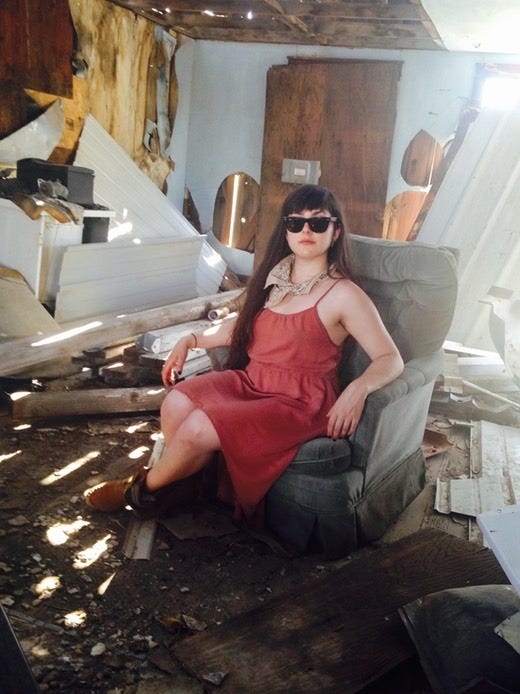
The first photo I ever used for an author bio captured me in an abandoned house in Cisco, Texas. Before the ghost town was turned into an artist residency destination, it was the kind of place that felt at once beautiful and dangerous. It reminded me of the town where I’d visit my great-grandmother as a child, where homes seemed abandoned, but you never knew who might be watching from a darkened window. The house in Cisco was crumbling, its walls stripped bare, sections of the floor ripped open to expose dirt and rock, light filtering through shattered windows, and entire chunks of roof collapsed into jagged piles. Yet, in that dilapidation, I saw a kind of renewal, an invitation to reimagine.
I chose the photo for my author bio in my first book of short stories, Life’s Too Short, because it reminded me of the authors who inspired me to write. Authors like Tom Robbins, whose photographs captured him wearing sunglasses, unapologetically cool. His half-smiles, casual jackets over t-shirts, and a palpable disregard for conventional appearance radiated a sense of unbothered selfhood. I wanted to radiate something similar: not indifference, but a kind of permission to exist fully, on one’s own terms.
In the photo, I wear sunglasses too, a loose dress that doesn’t bother with a shape, suede ankle boots, a sand-colored bandana, and a hair tie around my wrist. I’m not wearing makeup or contorting into an Instagram pose to make my arms look slimmer, my lips poutier, or my butt artificially rounder. It’s just me.
Back then, I was beginning to navigate the pronouns she/they, the fluidity they offered, and what it meant to embrace identity as multiplicity. It wasn’t always easy. Growing up, I often felt constrained by the expectations of femininity. Dresses chosen by my mother felt suffocating, like costumes for a performance I’d never auditioned for, an assault to my gender expression that went beyond just “not liking” something— it was about denying the multiplicity that was at the very core of who I was. Today, dressing femme feels different; it’s a choice I make deliberately, a role I play on my own terms. That’s why for now at least, my pronouns she/they/her/them feel right. I often present femme because that’s a space where I get to be creative and exploratory, a space where I find so much joy defining how I will navigate it, how I will re-define what was given to me at birth. I like glitter and corsets and pink and wigs and big puffy sleeves and rhinestone boots (that my mom helped me pick out) and commanding a room with feminine sensuality. But sometimes I don’t feel like a femme person. It’s not quite that I feel like a man, but that I don’t feel like a woman, either. If we’ve ever spent real time together, you know that if there’s no event, no themed hangout, no photographer or videographer, then you’re more than likely getting a no-frills, no makeup, hair unbrushed, coffee-stained shirt-wearing, sweatpants-loving, outdoorsy, camping enthusiast who half the time hasn’t properly rubbed in their sunscreen and doesn’t know it because they haven’t looked in a mirror that day.
There’s a kind of freedom in that unvarnished version of myself, a reminder that identity isn’t about meeting someone else’s expectations but about showing up as I am, whether polished or undone. That freedom is what drew me to the photo in the first place. It wasn’t perfect; it was honest.
That photo became a bridge, between past and present, between the person I was told to be and the person I was becoming, between the art I was told would be productive or successful to make, and the practices of creativity that would truly feed my soul. And, like that house in Cisco, I’ve come to see myself and my creative practices as structures that are constantly being rebuilt, shaped by the forces of time, culture, and my own creative energy.
Creativity as Resistance
In the current political climate, claiming this fluidity feels like an act of defiance. Creativity itself feels endangered in a system designed to prioritize production over process, results over exploration. Laws and policies across the United States have begun to strip away protections for artists, queer communities, and marginalized voices, creating an atmosphere where self-expression feels both urgent and precarious.
But perhaps creativity becomes most sustainable when it embraces the same fluidity that pronouns like they offer. To be creative in this climate is to allow for multiplicity, to make room for exploration, contradiction, and growth. It’s about rejecting the binary narratives of success versus failure, art versus activism, and instead asking: How can my work create space for others (including the other parts of myself) to thrive?
One way to approach this is by cultivating flexibility in your creative practice. Instead of focusing on a single project or medium, try experimenting with forms that challenge your usual perspective. If you’re a writer, sketch something. If you’re a musician, journal a scene from your day. Multiplicity in creativity isn’t about doing everything at once; it’s about recognizing that your voice can take different shapes.
Another strategy is to create intentionally collaborative spaces. Build a community where the creative process itself is prioritized over polished results. Host open-ended writing circles, collaborative murals, or art-making hangs with friends where everyone is encouraged to invite someone new— spaces where imperfection is welcomed, and creativity is a collective, ever-evolving act.
By embracing the fluid and the collaborative, creativity becomes an act of resistance against the forces that demand neat categorization or endless productivity. In a climate designed to exhaust, creating becomes a way to reclaim our energy, identity, and joy.
Art as a Practice of Becoming
For me, sustainability in art begins with rejecting conformity, whether it’s about how I should dress, how I should write, or what my art should look like. It’s about letting go of the need to constantly produce and embracing the quieter, slower rhythms of creativity.
This approach is deeply inspired by an Eileen Myles quote I read when researching the pronoun they, which Myles uses for its sense of fluidity. The quote reads, “I experience myself as a multiple.” Myles’ words remind me that creativity, like identity, is not fixed. It is fluid, messy, and always in conversation with the world around us.
In the face of political turbulence, this multiplicity feels radical. It’s a way of resisting the forces that seek to flatten identity and silence expression. It’s an insistence that art can be anything— scribbled lines in a notebook, a mural, a protest sign, or a song sung to oneself in the dark.
To make room for this multiplicity in your own practice, consider exploring a theme or subject across several forms. Write a poem, then paint how the poem feels. Record yourself speaking the poem aloud, letting the words take on a different rhythm. These layered approaches allow you to embody different facets of your creative self, each one valid and essential.
Another practice I cannot recommend enough is to set boundaries around your creativity. Allow yourself to say no to external demands or expectations that don’t align with your artistic values. This act of protecting your process is, in itself, a form of activism, one that honors your need to create authentically, rather than performatively.
By embracing multiplicity and setting boundaries, creativity becomes more than an act of expression. It becomes a practice of resilience, one that sustains both the artist and the world they’re reshaping.
What’s Next: Building Your Creative Resistance
This essay is just one part of a broader exploration of sustainable creativity in our current political moment. Over the coming weeks, I’ll dive deeper into the intersections of art, identity, and activism, exploring how we can build creative practices that sustain us and our communities.
Because, like that house in Cisco, we are all rebuilding, finding new ways to stand, to create, to be. And in doing so, we’re not just resisting— we’re reimagining what it means to exist fully, unapologetically, in a world that often demands otherwise.