Should I Work for Free? A Flowchart for Artists Who Know (Or Want To Know) Their Worth
Let’s start 2025 by holding everyone accountable (ourselves included) to recognize the real value of creative labor.

It’s only four days into the new year, and I’ve already been hit with multiple requests to do creative work for free. As an artist rolling out a new writing and performance workshop and co-launching a new arts-focused LLC this month, however, I’m taking a stand to value my expertise and time, and I hope others will follow suit.
Of course, I’ve had plenty of opportunities over the years— largely because I said yes to almost everything that came my way. Most of it was unpaid, but I did it because, like Lady Gaga, I lived for the applause! I thrived on making connections, building relationships, and showing up as an active, engaged creative in my community.
But here’s the thing: I can still do all of that— and I can (and should) be paid for it. These days, I’m older, more experienced, and frankly, exhausted! With a baby on the way, I’ve come to realize something crucial: giving away my energy, time, and resources without fair compensation isn’t just unsustainable— it’s actually a bit selfish. By saying yes to unpaid work, I’m inadvertently devaluing my expertise, and in some ways, the work of every other artist trying to make a living (and trying to feed their families.)
Of course, I still care deeply about enriching my community. Last year, I co-founded an arts nonprofit to help support other artists and amplify their voices. In just a short time, I’ve learned a lot about how comfortable and uncomfortable I am asking others to volunteer their time and creative energy, depending on what and who it benefits, how long it takes, how emotionally draining it is, etc. My commitment to the arts and having accessibility to them hasn’t wavered, but my priorities have shifted.
So why, even with my volunteer hours officially tapped out, do I still feel so guilty about saying no to requests for free work?
We artists often struggle with balancing personal boundaries and community impact due to a mix of societal pressures and systemic inequities. Creative work is frequently devalued, seen as a passion rather than a profession, with our expertise and years of practice (and expensive MFA degrees) dismissed as less deserving of fair compensation. Expectations of generosity compound this issue, with artists pressured to give back and sacrifice for their craft under the guise of community building. Meanwhile, businesses and nonprofits exploit artists by offering exposure instead of payment, using their presence to get people in the door to sell them anything from drinks to tattoos to streaming subscriptions— profiting off of the artists’ work without fair redistribution (sometimes even charging them exorbitant fees or commission to participate.)
This is further complicated by internalized guilt as many artists fear damaging relationships or losing opportunities by saying no.
But the deeply personal nature of art makes these requests feel like a devaluation of both identity and effort. For those from underrepresented communities, the weight of responsibility to uplift peers and contribute to cultural spaces adds another layer of complexity.
In a market with few safety nets and misaligned power dynamics, artists are often left to advocate for themselves, navigating the emotional and financial toll alone. This creates a persistent tension between supporting their community and ensuring their own survival— a balance that feels increasingly unsustainable in a world that undervalues creative labor.
So yesterday, after saying no to another request to show up and do the work for free, I sat down and drafted the following guide. I share it with you in hopes that it helps during those moments when you’re torn between generosity and setting boundaries. It’s not easy being an artist, especially when so many businesses and nonprofits— small and established alike— claim to support the arts but fail to compensate artists fairly. Supporting artists isn’t just a feel-good slogan to boost revenue; it’s an investment in the community and cultural growth.
Let’s start 2025 by holding everyone accountable, especially ourselves, to recognize the real value of creative labor. And if you think I should add anything, let me know!
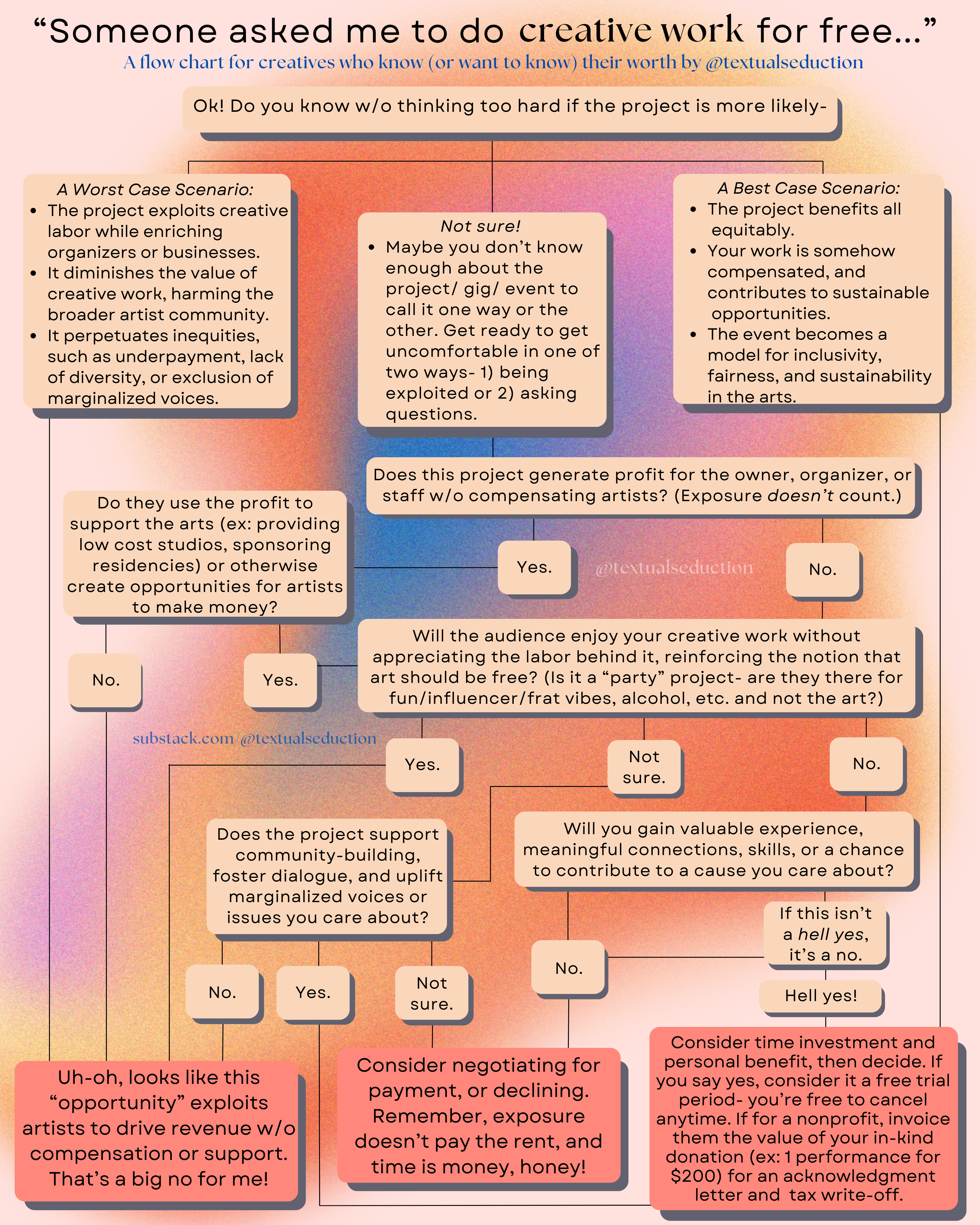
Alt Text For Flow Chart:
Title: Should I Work for Free? A Flowchart for Artists Who Know (Or Want To Know) Their Worth by @textualseduction
Path Descriptions:
Path 1: "Uh-oh, looks like this 'opportunity' exploits artists to drive revenue without compensation or support. That’s a big no for me!" If:
You answer yes to:
"Is the project a Worst Case Scenario?"
The project exploits creative labor while enriching organizers or businesses.
It diminishes the value of creative work, harming the broader artist community.
It perpetuates inequities like underpayment, lack of diversity, or exclusion of marginalized voices.
OR Yes to:
"Will the audience enjoy your creative work without appreciating the labor behind it, reinforcing the notion that art should be free?" (Is it a party project- are they there for fun/influencer/frat vibes, alcohol, etc. and not the art?)
OR No to:
"Do they use the profit to support the arts (low-cost studios, sponsoring residencies) or otherwise create opportunities for artists to make money?"
"Does the project foster community-building, dialogue, or uplift marginalized voices/issues you care about?"
Path 2: "Consider negotiating for payment or declining. Remember, exposure doesn’t pay the rent, and time is money, honey!" If:
Not sure about:
"Does the project foster community-building, dialogue, or uplift marginalized voices/issues you care about?"
OR No to:
"Will you gain valuable experience, connections, or a chance to contribute to a cause you care about?"
Path 3: "Consider time investment and personal benefit, then decide. If you say yes, treat it as a free trial—you’re free to cancel anytime. For nonprofits, invoice them for your in-kind donation for a tax write-off acknowledgment letter." If:
Yes to:
"Is the project a Best Case Scenario?"
The project benefits all equitably, compensates your work, and models fairness and inclusivity.
Your work is somehow compensated, and contributes to sustainable opportunities.
The event becomes a model for inclusivity, fairness, and sustainability in the arts.
OR Hell Yes to:
"Will you gain valuable experience, meaningful connections, skills, or contribute to a cause you care about?"